Destinations › Iwate › Hiraizumi
Takkoku no Iwaya: The Temple Hall Built into a Cliff
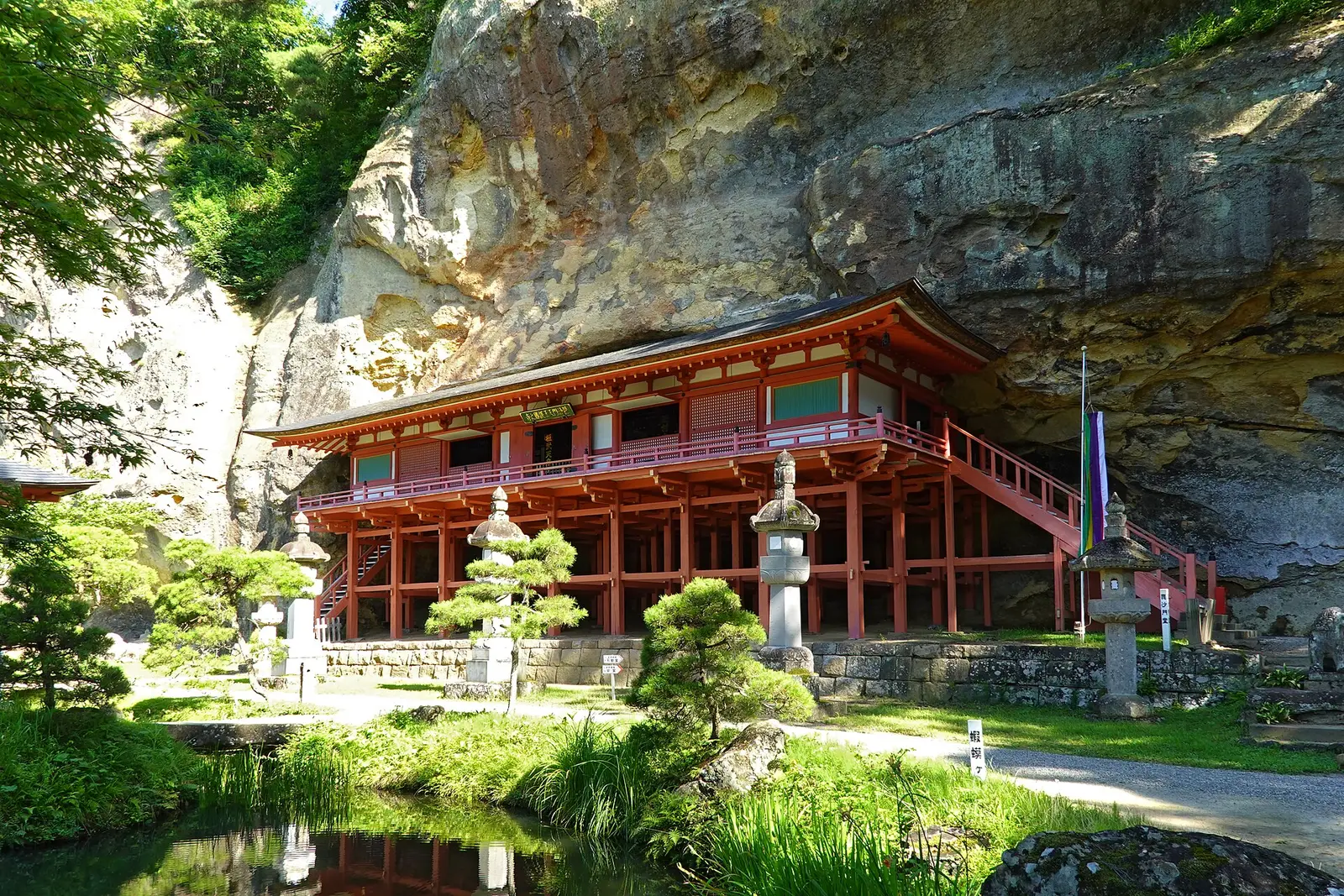
In a quiet valley a few kilometers from the center of Hiraizumi, a bright red hall stands on tall wooden posts, tucked into a hollow in a towering rock face. This is the Bishamon-do of Takkoku no Iwaya, a place of worship with a history of more than 1,200 years.
A general's thanks
The temple tells this story. About 1,200 years ago, Akuro-o and other Emishi chiefs built a fortress in the cave here and raided the countryside, carrying off women and children. Emperor Kanmu sent the general Sakanoue no Tamuramaro to defeat them, and in 801 he won.
Tamuramaro believed his victory was a gift from Bishamonten, a Buddhist god of war. To give thanks, he built a hall in the style of the famous stage of Kiyomizu-dera in Kyoto and placed 108 statues of Bishamonten inside. It was named the Iwaya Bishamon-do, the "Bishamon hall of the cave." The next year a temple, Takkoku Seikoji, was founded to look after it.
Through the centuries
Warriors kept coming here to pray. In the 11th century Minamoto no Yoriyoshi and his son Yoshiie gave land to the temple, and the Fujiwara lords of Hiraizumi are said to have built halls here. In 1189, after his army destroyed the Fujiwara, Minamoto no Yoritomo stopped to pray here on his way home, as the chronicle Azuma Kagami records.
The hall has burned and been rebuilt many times. Date Masamune rebuilt it in 1615. In 1946 a fire spread from a nearby house and destroyed the hall, though the main image and about twenty other statues were carried out. The present hall, rebuilt in 1961, is the fifth since the founding.
The main images are hidden Buddhas, kept in a shrine given by the Date family and shown only at long intervals. The next opening is planned for 2042.
The whole site is a National Historic Site. The town of Hiraizumi hopes to add it to the Hiraizumi World Heritage Site in the future.
The Buddha in the rock
West of the hall, a huge Buddha face is carved into a cliff about 33 meters high. Legend says Minamoto no Yoshiie carved it from horseback with the tip of his bow, to pray for the souls of everyone, friend and foe, who died in the wars of the 11th century. The figure is about 16.5 meters tall, with a face about 3.6 meters long. It is known as the northernmost cliff-carved Buddha in Japan. An earthquake in 1896 broke away the body below the chest, and the rock is still slowly wearing away.
The pond and its goddess
In front of the hall is Gama-ga-ike pond, with a small Benten hall on its island. Benten is a goddess of wealth, wisdom and the arts. According to the temple, she is a jealous goddess, so by old custom couples do not visit her together.
Excavations show that in the 12th century the pond was larger than today, with its banks covered in round stones, in the style of the Pure Land gardens of Hiraizumi.
Other halls
Himemachi Fudo-do holds a large Fudo Myoo statue carved from a single block of katsura wood in the late Heian period, a designated cultural property of Iwate Prefecture. The Kondo, the main hall of Seikoji, was rebuilt between 1987 and 1996 using traditional methods.
Visiting
Entry costs ¥500 for adults and ¥200 for junior and senior high school students, and elementary school children enter free. The site is open every day of the year.
The temple asks visitors to treat the grounds as a sacred precinct. Killing animals and picking plants are forbidden, and you may not smoke, eat, drink or bring pets. Follow the marked route if you want to pray. The temple suggests writing your wish on a wooden ema plaque for Bishamonten.
Getting there
Takkoku no Iwaya is about 6 km from JR Hiraizumi Station. Go by taxi, rental car or rental bicycle.
Nearby
Back in town, Motsu-ji and Chuson-ji are the two great temples of the Fujiwara lords.
More on Hiraizumi
 HIRAIZUMI3 min read
Chuson-ji: The Golden Hall of Hiraizumi
A hilltop temple of the Fujiwara lords, with a hall covered in gold leaf from 1124. What to see, hours and tickets.
 HIRAIZUMI3 min read
Motsu-ji: A Pure Land Garden from the Heian Period
A wide pond garden from the 12th century, the foundations of a vanished temple, and a famous haiku. Hours, prices and events.
 HIRAIZUMI3 min read
Geibikei Gorge: A Boat Ride Between 100-Meter Cliffs
A calm river between towering limestone cliffs, a boatman with a single pole and a folk song. Fares, timetable and access.