Japan's Election Vans: Why They Only Shout the Candidate's Name
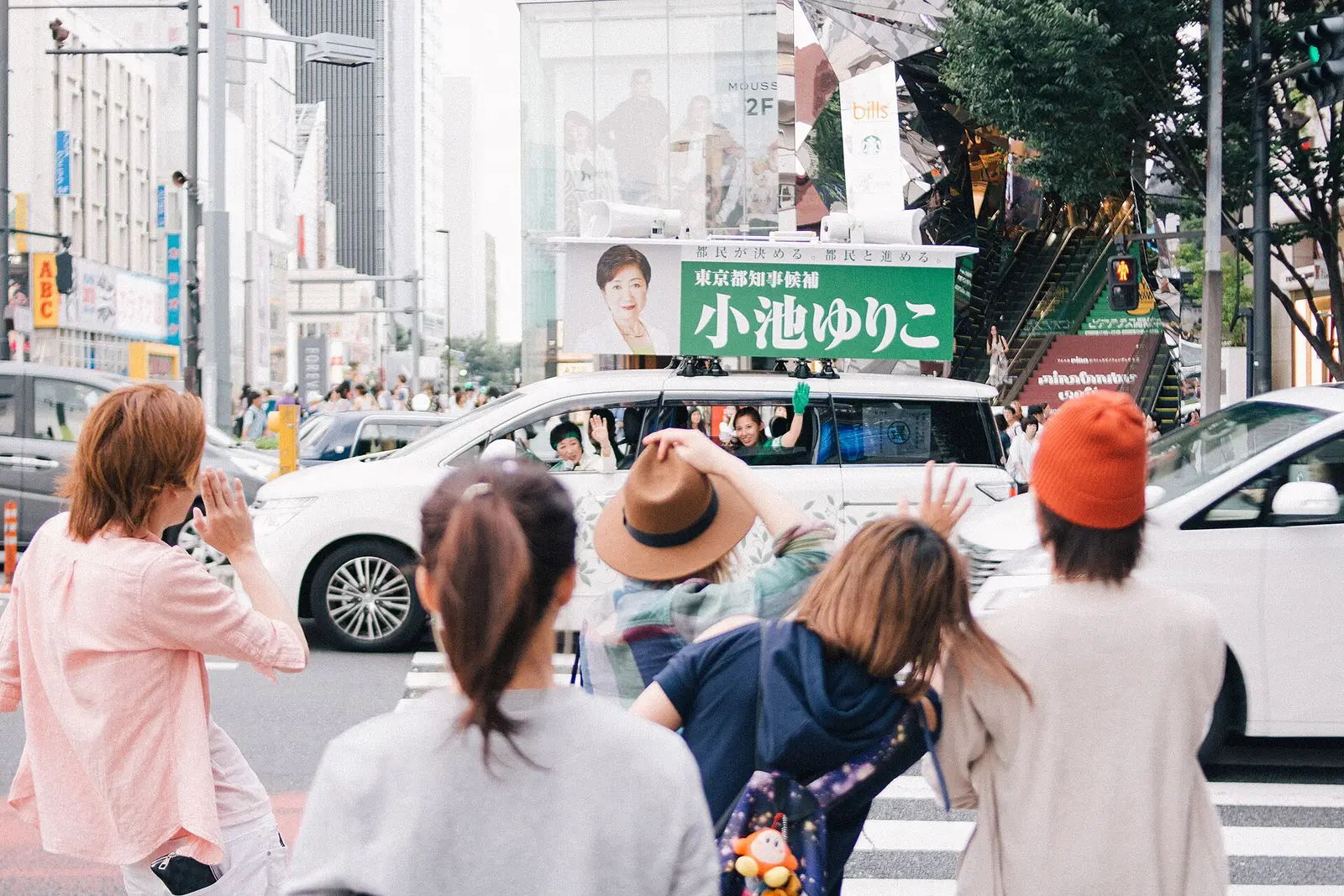
You are walking through Tokyo and a white van passes with loudspeakers on the roof, a name in huge letters on the side, and voices inside repeating that name over and over while gloved hands wave from the windows. Why do Japan's election vans only shout the candidate's name? Because the law allows a moving campaign car to do almost nothing else. This guide explains that rule, why the campaigns are so short, the numbers behind the van, who is inside and what they are paid, and what to do if one passes you.
What you are seeing
A campaign car. In the days before an election, every candidate gets one, and it spends the day driving slowly around the district with the candidate's name on the side and on the roof. Inside are the candidate, a driver and a few helpers, and what they say is mostly the name, "thank you," "please," and the name again. No policies, no arguments.
The short answer
The vans say so little because the law leaves them almost nothing to say. Japan's Public Offices Election Act bans campaigning from a campaign car, with two exceptions. One is giving a speech from the car while it is parked. The other is what the law calls renko, repeated short calls, which is allowed from a moving car between 8 am and 8 pm.
So while the car is driving, repeating the name is the only legal thing it can do. A van that started explaining a policy while moving would be breaking the law. The strange soundtrack is the law working as written.
Why the campaigns are so short
The same law says campaigning is only allowed from the day candidates officially register until the day before the vote. Before that, there is no campaign at all, and the vans stay in the garage.
How long that window is depends on the election. For the House of Representatives, the national lower house, the election date must be announced at least 12 days ahead. For the House of Councillors and for prefectural governors it is 17 days. For a town or village council, it is only 5 days. The vans are part of a short, concentrated burst, so candidates use every allowed hour of it.
The rules in numbers
Nearly every detail of the car is in the law or the cabinet order under it.
- One car per candidate. In most elections a candidate may use one car (or one boat) and one set of loudspeakers.
- A small car. It must have 10 seats or fewer and weigh under 3.5 tonnes, which is why they are almost always minivans and small vans, not trucks.
- An official sign. The car carries a sign issued by the election commission, so it can be checked.
- Up to four people plus the candidate and one driver. Anyone riding who is not the candidate or the driver wears an official armband.
- 8 am to 8 pm. Repeated calls from the car are allowed only in those hours. Street speeches are banned from 8 pm to 8 am.
- Keep it down near schools and hospitals. The law asks people making the calls to try to keep quiet around schools, hospitals and clinics.
- Keep moving. People giving street speeches are asked not to stay in one place for a long time.
Who is inside, and what they are paid
The voices you hear usually belong to hired announcers. In everyday Japanese they have a nickname, uguisu-jo, "warbler ladies," after a small bird known for its song, although men do the job too.
The pay is also fixed by law. Under the cabinet order, a person employed specifically to campaign from the car can be paid up to ¥20,000 a day. Office staff for the campaign are capped at ¥15,000 a day. There is a limit on how many paid people a campaign may use, and they have to be registered with the election commission in advance.
Who pays for the van
For national elections, a candidate can use the campaign car free of charge up to an amount set by the government, as long as they win enough votes to keep their deposit. Local governments can offer the same by local ordinance. So the van that woke you up was often partly paid for with public money, which is one reason the rules on it are so exact.
The next time one passes you
Now you know what you are hearing: a campaign with only days left, a crew of six at most, and a law that lets them say almost nothing but the name. The people inside wave at anyone who looks up, and waving back is fine. So are photos from the pavement.
If the noise gets too much, check the time. At 8 pm the loudspeakers go quiet, by law, until 8 am. And on the morning the vans do not come back at all, you will know what that means too. Campaigning ends the day before the vote, so the first quiet day is voting day.
More on Japan Explained
 JAPAN EXPLAINED3 min read
Why Do Japanese Front Doors Open Outwards? The Shoes
Doors that swing out toward you. The shoes behind them, and what Japan's building rules actually say.
 JAPAN EXPLAINED3 min read
Why Do Japanese Taxis Have Lace Seat Covers? The Clean Rule
White lace on the back seat. The national rule on clean taxis, and how the covers got there.
 JAPAN EXPLAINED3 min read
Why Japanese Train Stations Play Bird Sounds: The Stair Rule
That chirping on the platform is not a bird. The ministry guideline behind it, and what each station sound means.