Why Does Tokyo Have Red Lights on Buildings? The 60 m Rule
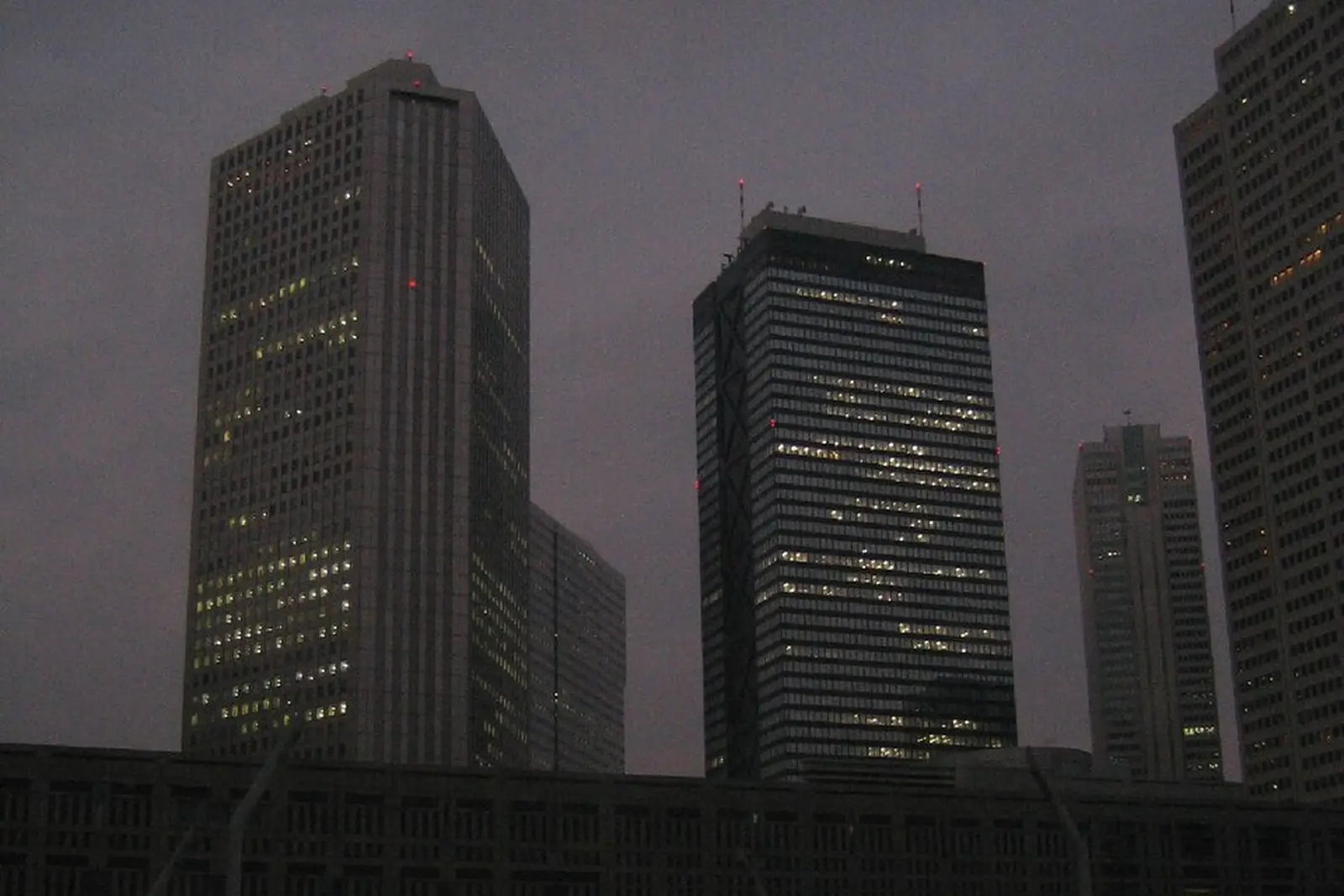
You look out of your hotel window at night and the Tokyo skyline is dotted with small red lights, some blinking slowly, some glowing steadily. Why does Tokyo have red lights on its buildings? Because Japan's aviation law requires warning lights on anything 60 meters or taller, and Tokyo has a great many tall buildings. This guide explains what you are seeing, the 60 m rule, how the lights are placed, and when a building may turn them off.
What you are seeing
From an observation deck or a high hotel floor, Tokyo at night shows rows of red dots. They sit on the rooftop corners of office towers, on the tops of antennas, and sometimes partway down the tallest buildings. Some blink in a slow rhythm. Others stay on all night. In Shinjuku's skyscraper district, many of these lights stand within a few streets of each other.
The short answer
Tokyo's buildings have red lights because Japan's Civil Aeronautics Act, the national aviation law, requires an aviation obstruction light on anything 60 meters or taller. The lights keep aircraft safe by showing pilots where tall structures stand in the dark. Tokyo has many buildings above that height, so the skyline fills with them.
What the law says
The rule is Article 51 of the aviation law. Whoever builds an object 60 m or more above the ground or water must install warning lights on it. The transport minister can grant an exception. Near airports, the airport operator must also light lower objects that stand in the flight paths.
The detailed rules sit in the ministry's regulations. They set four kinds of light:
- High-intensity white: a bright white flash for thin structures such as chimneys and steel towers of 150 m or more.
- Medium-intensity white: a white flash for the same kinds of structures under 150 m.
- Medium-intensity red: "aviation red" that blinks 20 to 60 times a minute.
- Low-intensity red: a steady red light that does not blink.
An ordinary office tower gets the red kinds on its roof, placed so pilots can see it from every direction. Very wide buildings get lights that trace their outline.
The rules in numbers
- 60 m: height above the ground or water that triggers the rule.
- 20 to 60: flashes per minute for a blinking red light.
- 52.5 m: maximum spacing for extra lights lower down a building of 150 m or more.
- 90 m: maximum spacing between steady red lights along a wide roof.
- 1960: year the system took its current basic form, according to the transport ministry.
The owner must also keep the lights working. The regulations even require spare bulbs and fuses, and contact with the ministry if a light stops.
Why Tokyo has so many
The ministry itself said so in 2003. It noted that taller and more crowded high-rise districts had left parts of big cities with a great many warning lights. It then relaxed the rules from December 25, 2003. Roof lights on buildings under 150 m could be spaced 90 m apart instead of 45 m. Lower towers next to the tallest one in a cluster could use weaker lights. Buildings standing side by side could skip some lights on their walls and roofs.
Why do some lights blink and others stay on?
The blinking ones are medium-intensity red lights, and the steady ones are low-intensity red lights. The regulations tie each kind to the height and shape of the building, so one tower can carry both.
Can a building turn its red lights off?
Yes, in one case. Since 2003, a building lit up well enough for pilots to see it can switch off its warning lights. The regulations say the minister must accept that the lighting does the same job.
Why are some towers striped orange and white?
That is the daytime half of the same law. Under Article 51-2, thin structures of 60 m or more that are hard to see by day, such as chimneys and steel towers, carry markings. Many are painted in alternating orange and white bands from the top down.
When you see them
Look for the red dots from any observation deck after dark, and count how many blink and how many stay steady. A bright white flash usually means something else. It marks a thin structure such as a chimney or a steel tower, not an office building.
More on Japan Explained
 JAPAN EXPLAINED3 min read
Japan's Election Vans: Why They Only Shout the Candidate's Name
White vans, loudspeakers and one name on repeat. The election law that makes them sound like that.
 JAPAN EXPLAINED3 min read
Why Do Japanese Front Doors Open Outwards? The Shoes
Doors that swing out toward you. The shoes behind them, and what Japan's building rules actually say.
 JAPAN EXPLAINED3 min read
Why Do Japanese Taxis Have Lace Seat Covers? The Clean Rule
White lace on the back seat. The national rule on clean taxis, and how the covers got there.