Why Are Japanese Hotel Rooms So Small? The 9 m² Rule
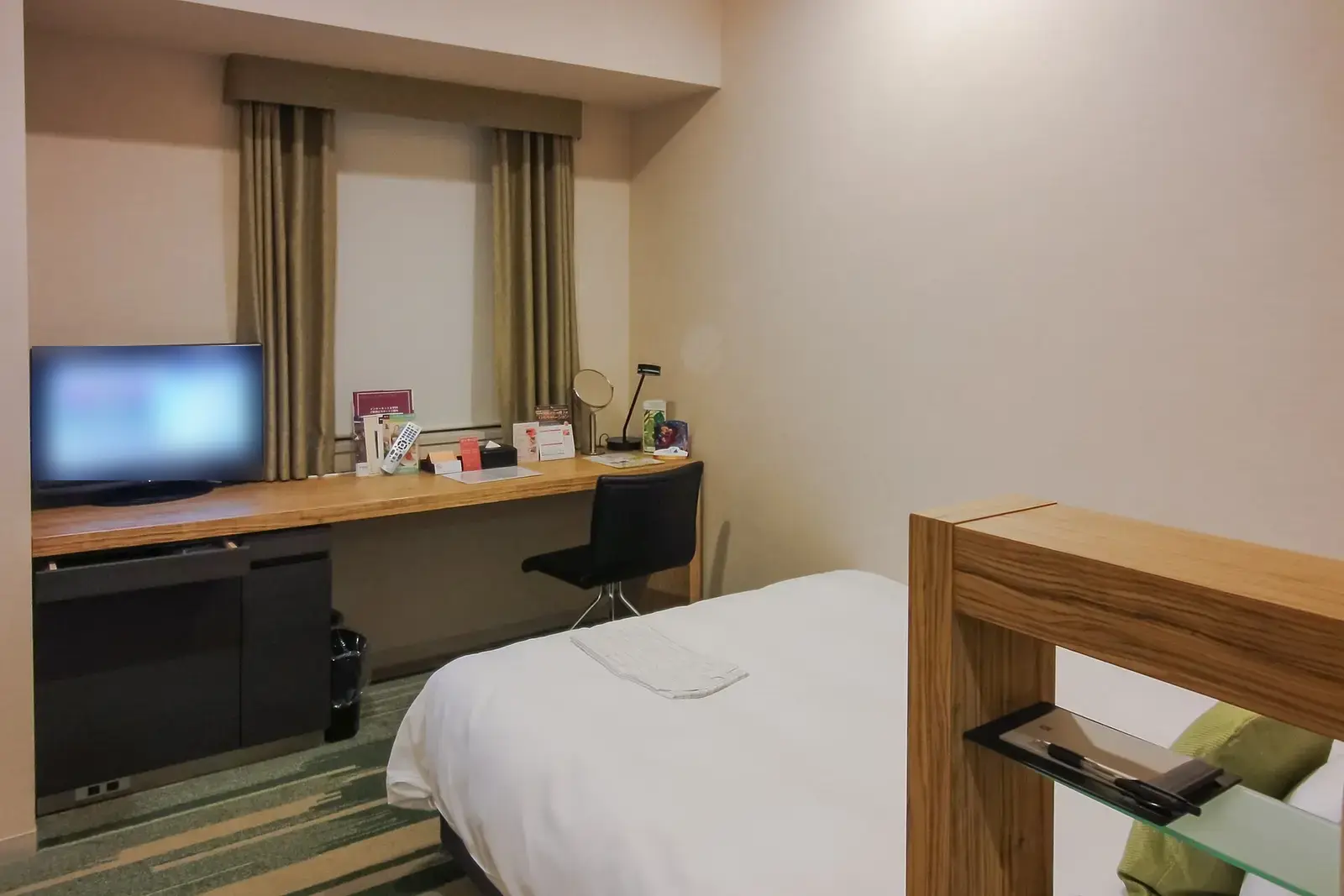
You open the door of your Tokyo hotel room, and the bed almost touches the desk, with barely space to open your suitcase. Why are Japanese hotel rooms so small? Because Japanese law lets a room with a bed be as small as 9 square metres, and nothing makes a hotel build bigger. This guide explains what you are seeing, the law behind it, the numbers, capsule hotels, and what to do when you book.
What you are seeing
A single room where the bed takes up most of the floor. A long desk runs along the wall with a TV and a lamp. There is a narrow strip of carpet between the two. You can open your suitcase on the floor or on the bed, but not on both.
You meet rooms like this most often in "business hotels". Japan's tourism agency counts these simple city hotels as their own type in its statistics.
The short answer
Japanese hotel rooms can be small because the law allows it. Japan's lodging rules say a hotel room with a bed must be at least 9 square metres, and a room without a bed at least 7. Anything above that line is the hotel's own choice, so a room near 9 square metres is fully legal.
What the law says
Every hotel, ryokan (traditional inn) and hostel in Japan needs a licence under the Inns and Hotels Act. A cabinet order under that act sets the building standards a licence requires. For an ordinary hotel or ryokan room, the rule is short:
- At least 7 m² for one guest room.
- At least 9 m² if the room has a bed.
That is the whole size rule for the room. For bathrooms, washbasins and toilets, the order asks only for a "suitable" size or number, with no figure. Each prefecture, and cities that run their own health centres, can add standards by local ordinance.
The rule changed in 2018
Until June 15, 2018, Japan had two separate licences. A "hotel" needed at least 10 rooms, and its Western-style rooms needed 9 m². A "ryokan" needed at least 5 rooms, and its Japanese-style rooms needed 7 m².
A 2018 reform merged the two into one licence. The minimum room count was dropped. The floor rule now depends on whether there is a bed, not on whether the room is called Western or Japanese.
The numbers
- 9 m²: a room with a bed, about 97 square feet.
- 7 m²: a room without a bed, such as a tatami (straw-mat) room with futons.
- 75.3%: rooms filled at business hotels in 2025, the highest of any hotel type, according to the Japan Tourism Agency.
- 81.5% and 82.9%: the same figure for business hotels in Tokyo and Osaka.
- 38.2%: rooms filled at ryokan in 2025.
How small can a capsule hotel be?
Capsule hotels and hostels use a different licence, for lodging where guests share the sleeping space. Their guest rooms must total at least 33 m², or 3.3 m² per guest if fewer than 10 guests are allowed. Where there are bunks, the gap between the upper and lower bed must be about 1 metre.
Are ryokan rooms bigger?
Not by law. A tatami room with futons only needs 7 m², less than a room with a bed. Before 2018, the same 7 m² applied to the Japanese-style rooms of a ryokan.
When you book a hotel in Japan
Look for the room size in square metres on the booking page before you pay. A room close to 9 m² is close to the legal minimum, so plan for one person and one open suitcase. If you are two people or carry large bags, filter for a bigger size, such as 15 or 20 m².
If you stay near a big station such as Shinjuku's station area, check the size twice. Business hotels in Tokyo filled 81.5% of their rooms in 2025, so book early if you need a bigger room.
More on Japan Explained
 JAPAN EXPLAINED3 min read
Japan's Election Vans: Why They Only Shout the Candidate's Name
White vans, loudspeakers and one name on repeat. The election law that makes them sound like that.
 JAPAN EXPLAINED3 min read
Why Do Japanese Front Doors Open Outwards? The Shoes
Doors that swing out toward you. The shoes behind them, and what Japan's building rules actually say.
 JAPAN EXPLAINED3 min read
Why Do Japanese Taxis Have Lace Seat Covers? The Clean Rule
White lace on the back seat. The national rule on clean taxis, and how the covers got there.