Why Are Japanese Gas Stations So Tall? Pumps on the Ceiling
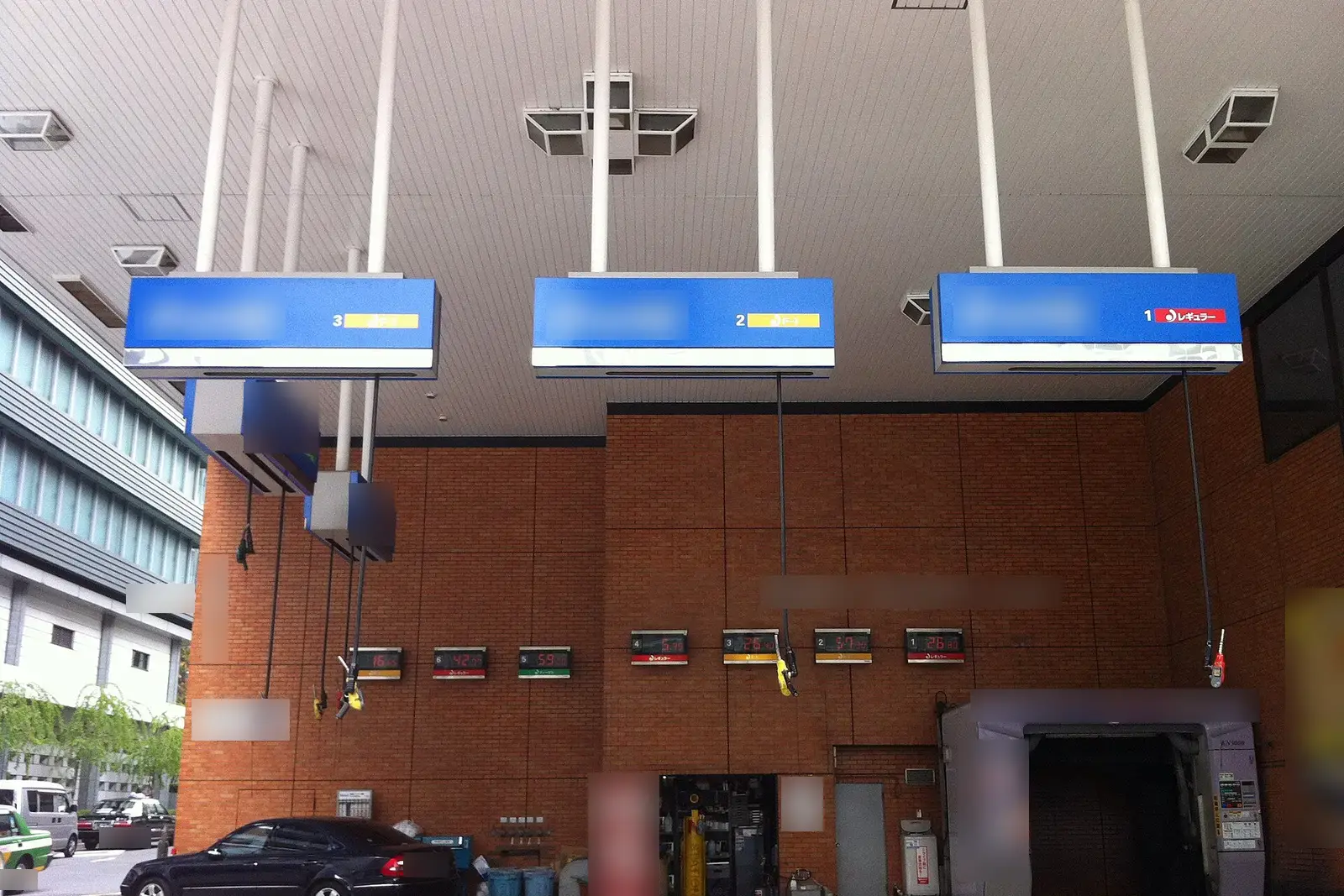
You walk past a gas station in central Tokyo and see no pumps on the ground. Instead, boxes hang from a high roof, with hoses dropping down to the cars. Why are Japanese gas stations so tall? Because many city stations hang their pumps from the roof, and the fire rules let the hose heads sit up to 4.5 meters high. This guide explains why the pumps hang, why the roof sits so high, the rules in numbers, and what to do at one.
What you are seeing
A gas station with nothing on the floor. In much of the world, pumps stand on concrete islands. Here, the floor is flat and open, and the pumps are boxes fixed to a ceiling high above it. A hose hangs from each box, and a staff member pulls it down to fill the car.
Not every station in Japan looks like this. Many have ordinary pumps on the ground. But in city centers you will see the hanging kind, under a noticeably high roof.
The short answer
Japanese gas stations look tall because many city stations hang their pumps from the roof instead of standing them on the ground. Japan's fire rules for fuel stations allow these hanging pumps, called kensui-shiki, suspended type, and let their hose heads sit up to 4.5 meters high. The roof has to clear that.
Every gas station handles hazardous materials. So its layout is set in detail by rules under Japan's Fire Service Act, and hanging pumps have their own lines in them.
Why hang the pumps from the roof
The rules do not say why a station chooses hanging pumps. What they do show is what a station gains.
A pump on the ground has to stay 4, 5 or 6 meters back from the road, depending on how long its hose is. A hanging pump needs 4 meters, whatever its hose. And each pump needs an open space at least 10 meters wide and 6 meters deep where cars stop to fill up. For a hanging pump, that space is simply the floor under it, with no island in the way.
On a small city lot, that floor space matters. Many lots face streets that are themselves tight, as our guide to Japan's 4-meter street rule explains. The hanging design lets cars drive in and stop where they need to.
Why the roof sits so high
Japan's road rules let ordinary trucks be up to 3.8 meters tall, or 4.1 meters on designated roads. The pumps hang under the roof, with the hose outlet no higher than 4.5 meters. So a station that wants trucks to drive under its pumps needs a roof well above head height. That is our reading of the two rules together. Neither rule mentions the other.
The rules in numbers
- 4.5 m. The highest the hose outlet of a hanging pump may be.
- 3 m. The hose must be short enough that its nozzle cannot reach beyond a 3 m circle under the pump.
- 4 m. The minimum gap between a hanging pump and the road.
- 10 m by 6 m. The minimum open space for cars at each pump.
- One third. If the roofed part covers over a third of the open ground, the station counts as indoor, with stricter rules.
- Emergency stop. A station with hanging pumps must be able to stop fuel coming up from the underground tank.
Why are the hoses so short?
Because the rules cap their reach. The nozzle may not reach more than 3 meters from the point under the pump. So the car has to stop close below it.
Why is there a wall around the station?
The rules require a fireproof wall or fence at least 2 meters high on every side of the station except where cars come in. It is there to stop a fire from spreading.
Are gas stations disappearing in Japan?
There are fewer every year. The government counted 27,009 registered stations at the end of March 2025. Nine years earlier, in March 2016, there were 32,333, and the number fell every year in between.
If you see one
Look up. The boxes on the ceiling are the pumps, and the high roof is there to clear them. If you drive a rental car into one, stop with your fuel cap right under the hose for your fuel. The hose will not reach far. If staff come out to fill the car, stay seated and let them bring the nozzle down. And at night, take a second look at the roof: it is built to clear a truck.
More on Japan Explained
 JAPAN EXPLAINED3 min read
Japan's Election Vans: Why They Only Shout the Candidate's Name
White vans, loudspeakers and one name on repeat. The election law that makes them sound like that.
 JAPAN EXPLAINED3 min read
Why Do Japanese Front Doors Open Outwards? The Shoes
Doors that swing out toward you. The shoes behind them, and what Japan's building rules actually say.
 JAPAN EXPLAINED3 min read
Why Do Japanese Taxis Have Lace Seat Covers? The Clean Rule
White lace on the back seat. The national rule on clean taxis, and how the covers got there.