Why Do Japanese Restaurants Close in the Middle of the Day?
It is 3 pm, you are hungry, and the little restaurant you picked has a sign by the door that says 準備中. Why do Japanese restaurants close in the middle of the day? Because most are tiny places that run two busy services, lunch and dinner, with only a handful of workers. This guide explains what the sign means, how small these places are, what Japan's labor law says about breaks, and how to plan your meals around it.
What you are seeing
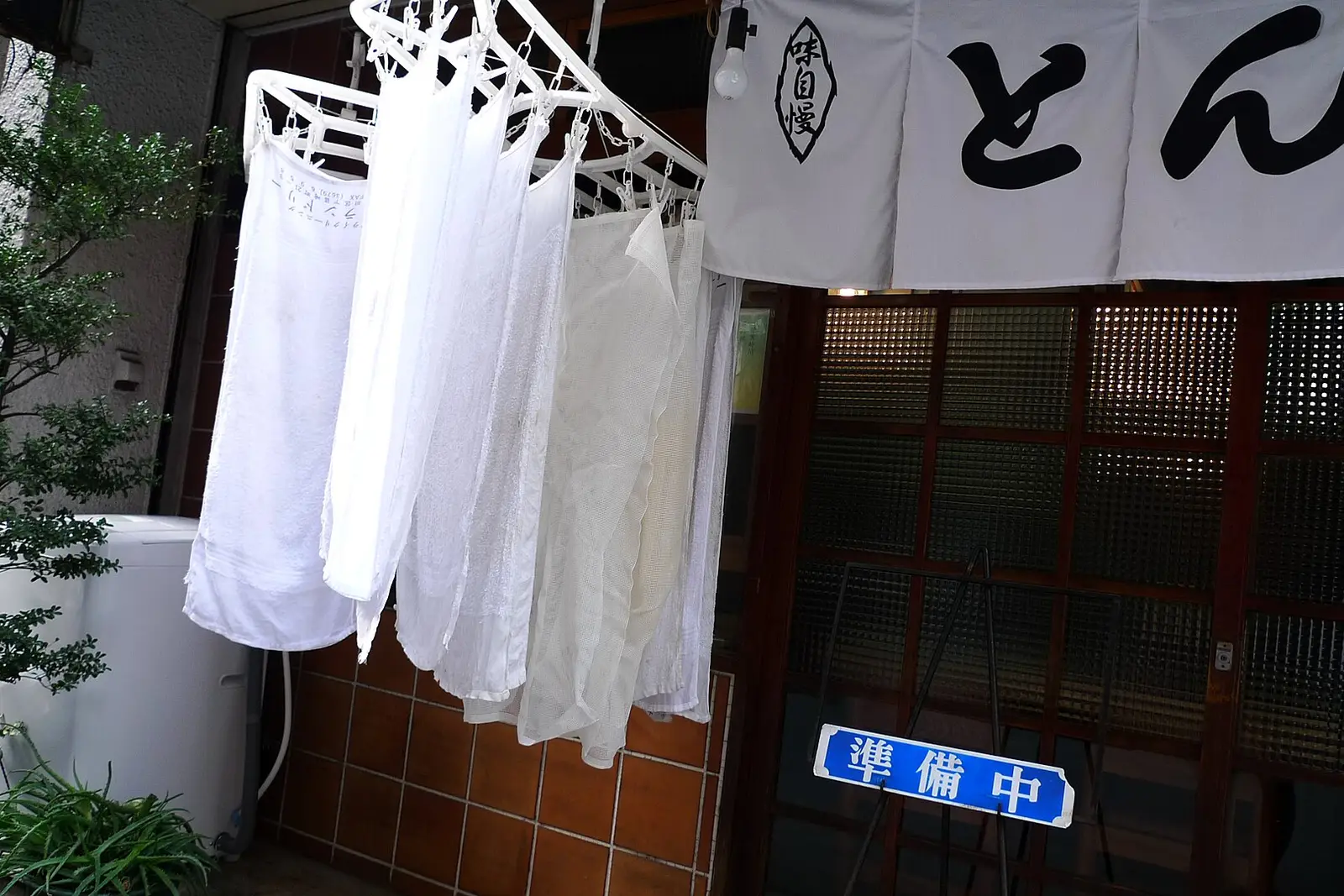
You walk down a side street after a late lunch plan falls through. The lights are off, the door is shut, and a small sign hangs by the entrance. It reads 準備中, junbichu, meaning "getting ready." In the photo above, a pork cutlet restaurant has hung its towels out to dry while it waits for dinner.
The short answer
Japanese restaurants close in the middle of the day because most are small places serving two rush hours with a tiny team. A government survey of ordinary diners found an average of 4.6 workers each. Closing in the quiet afternoon gives that small team its legal break, and the sign on the door says the kitchen is getting ready.
How small these restaurants are
Japan's health ministry surveys small food businesses every few years. In 2008 it studied 397 shokudo, everyday diners. The numbers show a business built around family and part-time help:
- 4.6 people worked at the average diner.
- 3.1 people worked at the average owner-run diner.
- 2.3 of the 4.6 were temporary or part-time workers.
A 2013 survey of noodle shops for soba and udon found almost the same picture. The average shop had 4.9 workers, and owner-run shops had 3.9.
What the labor law says
Japan's Labor Standards Act sets the length of a working day. A worker on duty for more than six hours must get at least 45 minutes of break. Over eight hours, the break must be at least one hour. It has to fall in the middle of the working day, not at the end.
The same article says breaks should usually be given to everyone at the same time. Restaurants, hotels and shops are exempt from that part. So the law does not force a restaurant to close. A large one can give breaks in turns and stay open all day.
A team of three or four has no one to cover for the cook. A day that runs from 11 am to 8 pm is nine hours long. Closing the door between the two rushes is the simplest way to fit everyone's break into that day.
The rules in numbers
- 8 hours a day, 40 a week: the usual legal limit on working time.
- 44 hours a week: the limit for restaurants with fewer than 10 workers.
- 45 minutes: the minimum break after six hours of work.
- 1 hour: the minimum break after eight hours.
- 62.2%: diners that open in the 11 o'clock hour (2008 survey).
- 8.5 hours: the average time a diner was open each day.
Is the afternoon closing required by law?
No. The law sets how long a worker's break must be, not when a restaurant must shut. Restaurants are even allowed to give breaks one person at a time.
Do restaurant workers in Japan have long days?
Many do. In the 2013 noodle shop survey, "9 hours or more" was the most common working day where full-time staff were employed. It was the answer at 32.5% of those shops.
When you eat out in Japan
Plan lunch for the late morning or early afternoon, and dinner from the early evening. If you see 準備中 on the door, the restaurant is not closed for good. It is getting ready, so check the hours board by the entrance and come back later. Eating late? Read why Japan's trains stop around midnight so dinner does not cost you the last train.
More on Japan Explained
 JAPAN EXPLAINED3 min read
Japan's Election Vans: Why They Only Shout the Candidate's Name
White vans, loudspeakers and one name on repeat. The election law that makes them sound like that.
 JAPAN EXPLAINED3 min read
Why Do Japanese Front Doors Open Outwards? The Shoes
Doors that swing out toward you. The shoes behind them, and what Japan's building rules actually say.
 JAPAN EXPLAINED3 min read
Why Do Japanese Taxis Have Lace Seat Covers? The Clean Rule
White lace on the back seat. The national rule on clean taxis, and how the covers got there.