Why Do Japanese Houses Have Rocks on the Roof?
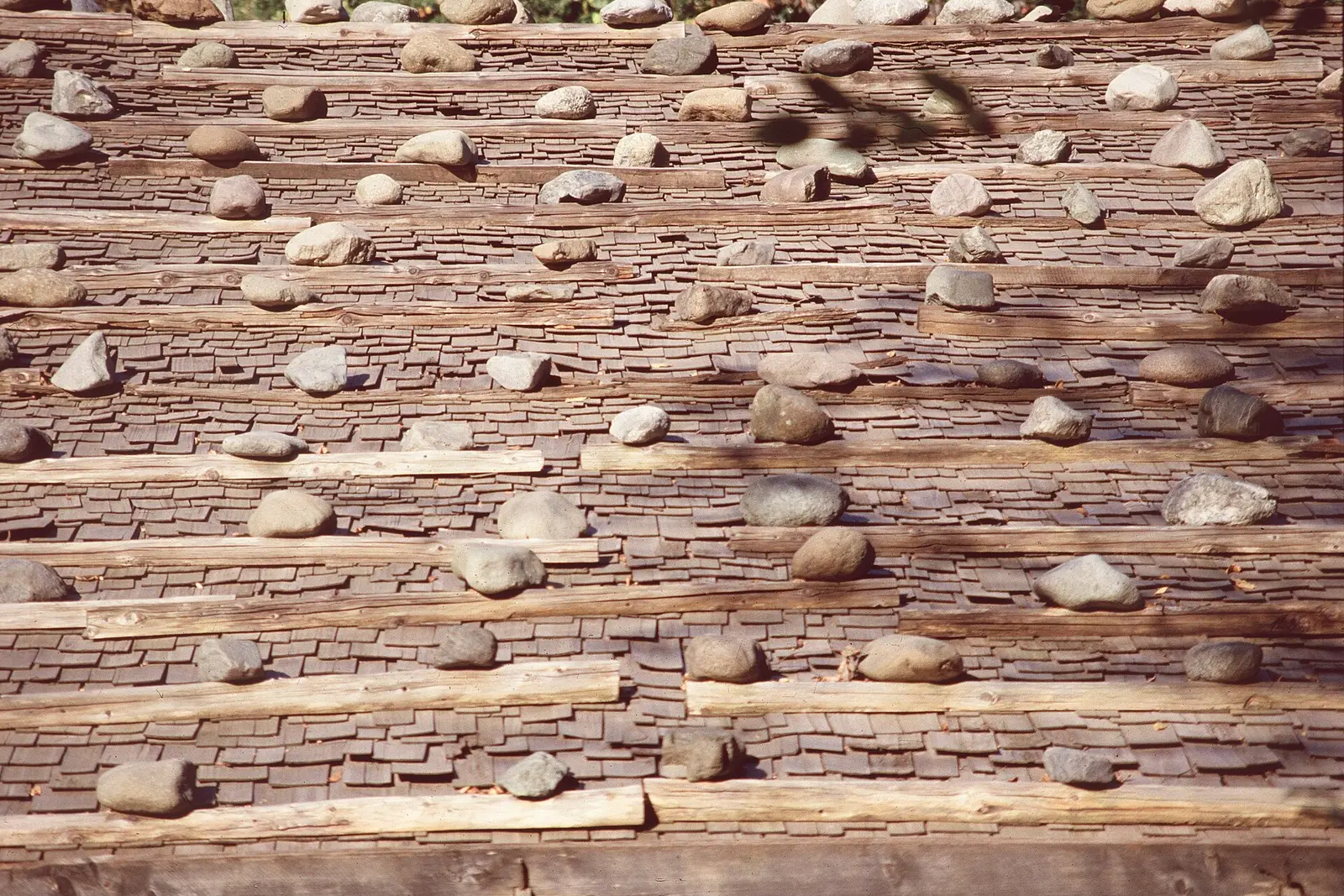
You look up at an old wooden house in Japan and see rows of round stones sitting on the roof. Why do Japanese houses have rocks on the roof? Because the roof is made of thin wooden shingles, and the stones are what hold them down. This guide explains what you are seeing, how the roof works, why most were replaced, the rules in numbers, and where you can still see one.
What you are seeing
The roof is not tile. Look closer and it is made of small, thin boards of wood, laid in overlapping rows. Long timbers run across the roof from side to side. On top of the timbers sit round stones, spaced along each row.
Nothing is nailed that you can see. The stones are not decoration. They are part of the roof.
The short answer
Japanese houses have rocks on the roof because the roof is covered with thin wooden shingles that are not nailed down. The stones press the shingles and the long timbers against the roof, so wind cannot lift them. This style is called ishioki itabuki, a board roof with stones on top.
How the roof works
The boards are laid in rows from the eaves up to the ridge, each row covering the one below. Timbers are laid across the rows. The stones sit on the timbers and hold everything down by weight alone.
That only works on a gentle slope. On a steep roof, the stones would roll off.
An American scientist who traveled in northern Japan described these roofs in a book published in 1885. He wrote that shingled roofs were "weighted with stones" so the high winds would not blow them away, and that this was most common in Hokkaido.
Why most were replaced
Japanese town records show where these roofs went. Takaoka, a historic town in Toyama, writes in its plan for the Kanaya-machi district that its old houses originally had stone-weighted board roofs, and that they now have tile.
Yokote, in Akita, writes the same for its Masuda district. Old main houses there had thatch, boards, or stones on top. Then came metal sheet roofs, and now only metal sheet roofs remain.
The rules in numbers
- Article 62: in fire-prevention districts, every roof must meet a national standard against sparks from a fire in town
- Article 22: outside those districts, the local government can mark areas where the same kind of rule applies
- 10 m²: sheds this small, and tea houses, are partly exempt from Article 22
- Article 3: the Building Standards Act does not apply to buildings designated as national cultural properties
- Article 85-3: in a preserved historic district, the town can relax the roof rules by its own ordinance, with national approval
Are there still houses with rocks on the roof?
Yes, but few. In Takaoka and Yokote, the official plans say none of the original stone roofs are left. Your best chance is a protected old house or a historic district, where the law lets the old style stay.
Can you build a new stone roof today?
Only with care. In fire-prevention districts and other areas the town has marked, a new roof must meet the national fire standard against sparks. Protected buildings and historic districts can be exempt. The same building law also shapes Japan's 4-meter street rule.
If you see one
Stop and look at the timbers. Each row of stones sits on a long piece of wood, not on the shingles alone. Count the rows from the eaves to the ridge.
Then look around. If the houses nearby have tile or metal roofs, you are looking at what most of them were, a long time ago. And while you are walking past old houses, check which way the doors open: Japanese front doors open outward for a reason too.
More on Japan Explained
 JAPAN EXPLAINED3 min read
Japan's Election Vans: Why They Only Shout the Candidate's Name
White vans, loudspeakers and one name on repeat. The election law that makes them sound like that.
 JAPAN EXPLAINED3 min read
Why Do Japanese Front Doors Open Outwards? The Shoes
Doors that swing out toward you. The shoes behind them, and what Japan's building rules actually say.
 JAPAN EXPLAINED3 min read
Why Do Japanese Taxis Have Lace Seat Covers? The Clean Rule
White lace on the back seat. The national rule on clean taxis, and how the covers got there.